
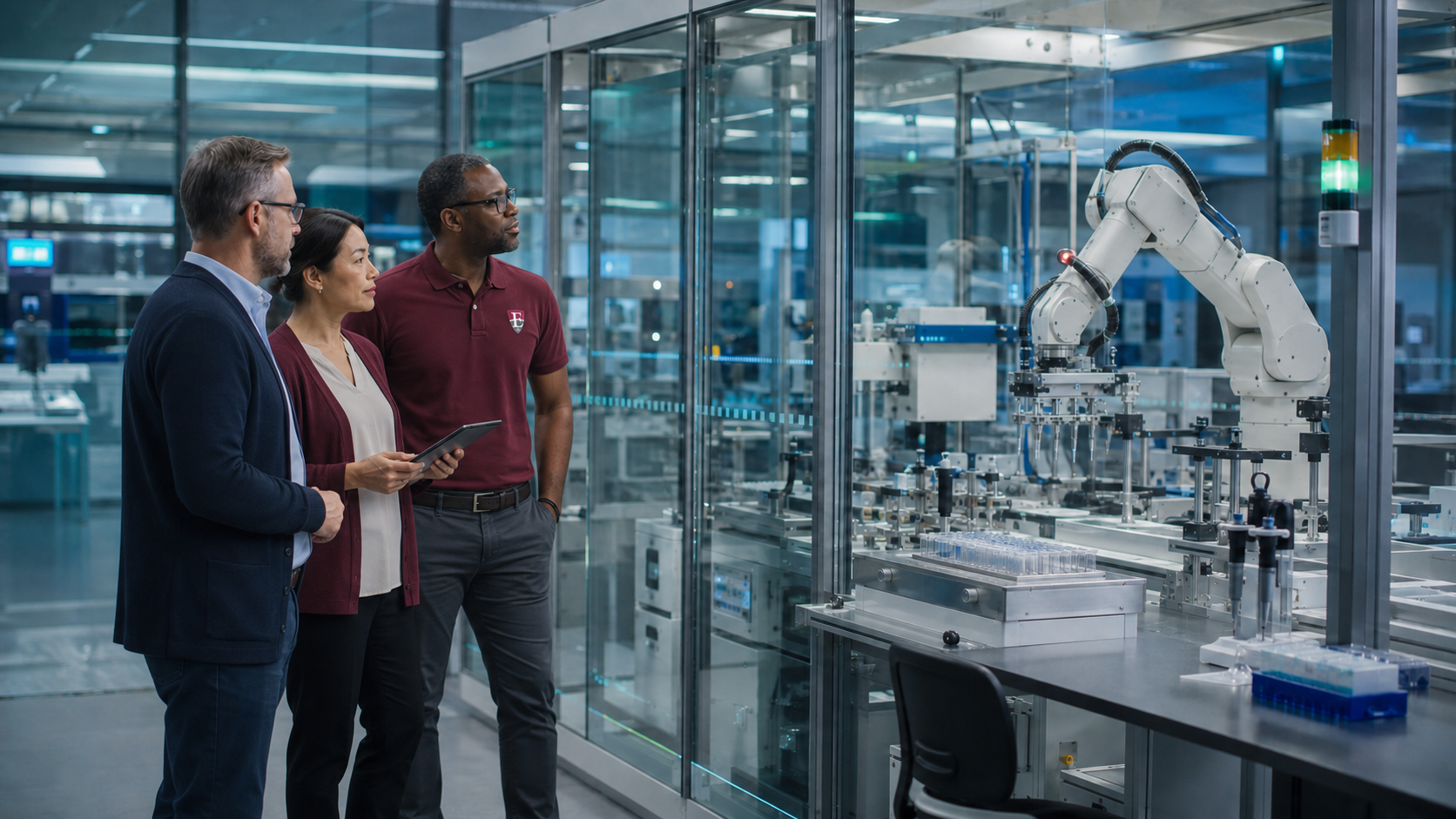
For most executives, the risks of generative AI have lived inside a screen. A model might invent a citation, expose sensitive information, write flawed code, or recommend the wrong action.
That risk changes category when the AI can move a robotic arm, adjust a laser, operate a liquid handler, or stop a laboratory procedure.
On August 27, Anthropic introduced a research preview of the Model Hardware Standard, or MHS. The proposed interface allows AI agents to discover and operate programmable laboratory and manufacturing equipment through a common set of commands. Anthropic says early collaborators used it to connect instruments that normally require custom integrations and to coordinate multistep physical workflows.
The announcement is early, vendor-led, and not evidence that autonomous laboratories or factories are ready for broad deployment. It remains strategically important because it points to a new layer in the enterprise AI stack: a common interface between model reasoning and physical action.
The interface may become more important than the model
Industrial and laboratory automation has always involved integration work. Equipment from different manufacturers may expose different software interfaces, data formats, operating modes, or no modern application programming interface at all. Connecting a plate reader, liquid handler, camera, and robotic arm can require specialists to build and maintain custom software to integrate them.
MHS proposes a standardized driver that describes a device in a format an agent can understand. Its basic actions include reading a temperature or writing a new set point. Metadata can describe what the equipment measures, which settings can change, and which safety limits apply.
In the demonstrations reported by Anthropic and its collaborators, the same interface allowed an agent to coordinate several incompatible devices. A Carnegie Mellon University team reported building drivers and an orchestration layer in about eight hours for a setup that normally required weeks of work. In a Genentech proof-of-concept study, an agent coordinated three instruments and adjusted liquid-handling parameters based on experimental results.
Those are promising case reports, not independent performance benchmarks. Yet the business signal is clear: standardization can reduce the cost of connecting intelligence to equipment. If interfaces such as MHS mature, companies may be able to change models, add instruments, and redesign workflows without rebuilding every connection from scratch.
That shifts strategic value away from a single impressive model demonstration and toward the operating layer around it: device definitions, workflow logic, safety controls, proprietary process knowledge, and the data generated by repeated execution.
A shorter integration cycle creates a larger control surface
The same abstraction that makes a system easier to deploy can make authority easier to scale.
If one agent can discover several machines and issue commands through a shared interface, a configuration error or an inappropriate instruction may propagate farther than it would in an isolated system. A software mistake is no longer limited to an incorrect answer. It may affect material, equipment, production time, worker safety, product quality, or a regulated experimental record.
Anthropic's own account illustrates the boundary. During a liquid-handling test, the model initially responded to bubbles by retrying the operation, which worsened the physical condition. Human experts had to explain the underlying constraint before the lesson was incorporated into reusable instructions. General reasoning did not automatically produce reliable physical intuition.
This is why physical AI cannot inherit governance from office copilots alone.
NIST defines operational technology as programmable systems or devices that interact with the physical environment and emphasizes cybersecurity risk management as necessary for safe and reliable delivery. The 2025 ANSI/A3 robot-safety update likewise separates requirements for robots from requirements for robot applications and cells, stressing that safety belongs to the entire application rather than to the robot alone.
An AI agent adds another component to that system. It does not erase the responsibilities already assigned to equipment manufacturers, system integrators, asset owners, operators, cybersecurity teams, and safety professionals.
Give the agent an authority envelope
Before a pilot begins, the business owner and technical team should write an authority envelope: a precise description of the conditions under which the agent may observe, recommend, act, pause, or stop.
That envelope should answer six questions:
- What can the agent see? Identify the sensors, device states, process data, instructions, and historical records available to it.
- What can it change? List permitted commands, parameter ranges, equipment, materials, and workflow stages.
- What must remain independent? Keep emergency stops, hard limits, collision avoidance, hazardous-material controls, and other safety functions outside the model's discretion.
- When is human approval required? Define thresholds for novel procedures, out-of-range conditions, destructive actions, production changes, and recovery from unexpected failures.
- What evidence must be retained? Record observations, proposed actions, executed commands, results, overrides, model and configuration versions, and the identity of approving operators.
- What ends the run? Establish automatic pause and shutdown conditions before the system encounters them.
These controls should be enforced in the architecture, not stored only in a policy document or prompt. ISA's 2025 guidance on industrial AI identifies human safety, system reliability, data quality, explainability, information protection, and standards-aligned deployment as central concerns. A December 2025 update to ISA/IEC 62443 adds risk-based methods for developing, validating, operating, and maintaining security protection schemes across the industrial-control lifecycle.
The practical lesson is that the model should propose within a bounded space while deterministic systems enforce the boundary.
Start with observation, then earn the right to act
The best first use case for physical AI may not involve autonomous control.
An agent can begin in observation mode: reading equipment state, consolidating data from multiple instruments, detecting anomalies, or recommending the next step to a qualified operator. This exposes integration gaps and reasoning failures without immediately granting the system authority to move equipment or change a process.
The next stage can allow low-consequence actions inside narrow limits. Only after the organization has accumulated evidence should the agent receive broader authority. NIST's 2026 draft TEVV-Athlon framework explicitly includes agentic systems and calls for assessments customized to organizational objectives that produce evidence about performance and negative impacts. Each expansion should be tied to demonstrated performance, tested failure modes, and a named business owner.
This progression also improves the investment case. Leaders can measure integration time, operator attention, experiment throughput, downtime, scrap, rework, recovery time, and safety incidents at each stage. A successful pilot is not one in which the agent completes an impressive demonstration. It is one in which the organization can show that the new operating model is safer, faster, more reliable, or economically superior under defined conditions.
NIOSH warns that algorithms can alter the risk profile of the physical platforms they control or interact with. Its 2026 guidance recommends collaborative safety evaluations, independent audits, certification approaches, and safety-system or safety-case methods for high-risk AI. That same balance should appear in the business case. Labor savings without safety, quality, and resilience measures provide an incomplete picture of value.
The durable advantage is disciplined learning
If common hardware interfaces take hold, access to physical AI will become easier for competitors too. The interface itself may not remain a durable differentiator.
The advantage will come from what the organization learns while using it: which process parameters matter, how exceptions are resolved, where expert judgment enters the workflow, which failures recur, and how rapidly those lessons become validated operating rules.
This is a strategy-execution problem. The executive team chooses where autonomy could create value. Engineers and operators translate that intent into bounded workflows. Safety and cybersecurity teams define non-negotiable constraints. Performance evidence then determines whether the system remains a pilot, expands, or stops.
The companies that do this well will not confuse machine access with machine readiness.
MHS may eventually become an open standard, be replaced by another interface, or remain concentrated in specialized settings. The larger transition is already visible: AI is moving from generating content to operating systems that sense and alter the physical world.
When AI gets hands, governance can no longer be a review meeting held after deployment. It has to be part of the machinery.
Questions for executives
- Which physical workflows could benefit from AI coordination without requiring immediate autonomous control?
- What safety, quality, and cybersecurity limits must remain deterministic and impossible for the model to override?
- What evidence would an agent have to produce before earning broader authority over equipment or processes?
Sources and further reading
- Previewing the Model Hardware StandardAnthropic · 2026-08-27
- Operational Technology SecurityNational Institute of Standards and Technology · Updated 2026-01-22
- ANSI, A3 Publish Revised R15.06 Industrial Robot Safety StandardAssociation for Advancing Automation · 2025-09-10
- ISA Explores Industrial AI's Impact on Automation in a New Position PaperInternational Society of Automation · 2025-11-06
- Update to ISA/IEC 62443 Series Includes Guidance on Security Protection Schemes for IACSInternational Society of Automation · 2025-12-04
- The TEVV-Athlon Framework for Evaluating AI SystemsNational Institute of Standards and Technology · 2026-08-07
- Practical Strategies to Manage AI Hazards in the WorkplaceNational Institute for Occupational Safety and Health · 2026-01-18