
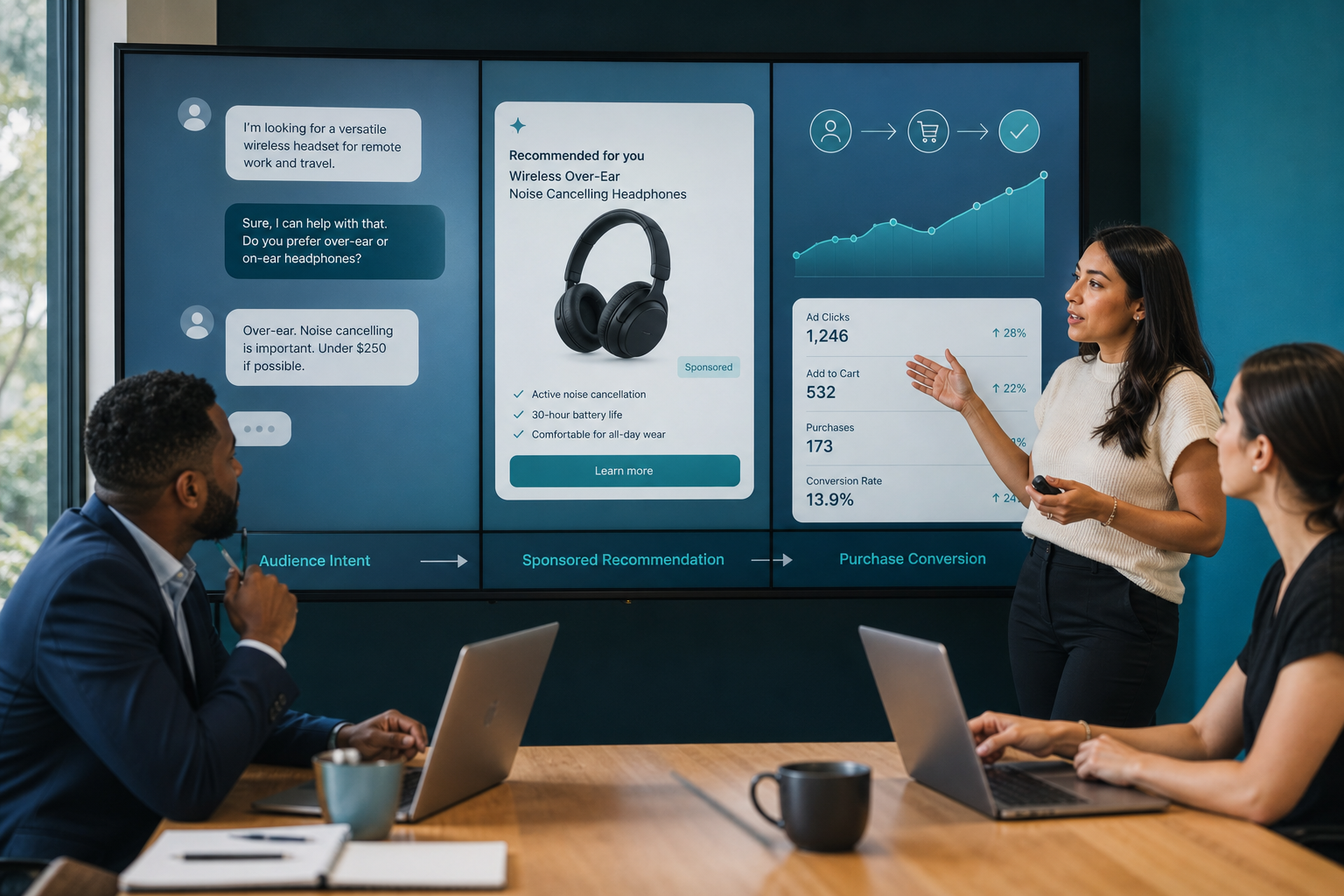
The next media channel is a conversation
Someone asks ChatGPT to plan a family trip to Rome. Another person compares payroll platforms for a 40-person company. A homeowner wants to know which heat pump fits an older house.
These do not look like searches in the traditional sense. They look like conversations. Yet each one contains something marketers have spent decades trying to find: a person actively working through a decision.
On August 24, ChatGPT Ads became available across 31 European markets, following six months of testing in the United States. OpenAI says ads will appear only for users on its Free and Go plans, remain clearly separated from answers, and will not influence what ChatGPT recommends.
For businesses, that separation is the most important detail.
Paying for placement may put a brand beside the conversation. It does not buy a place inside the answer. Companies now have two different jobs: earn visibility in the AI-generated response and decide whether paid placement near that response is worth buying.
Traditional advertising begins with a proxy for intent. A keyword, website visit, or past purchase suggests what someone might want.
Conversational AI receives something richer. A user may describe the outcome they need, the constraints they face, the alternatives they are considering, and the reason the decision matters. That context can reveal not only what the customer is looking for, but how the customer is thinking.
OpenAI is positioning ChatGPT Ads around exploration, comparison, and decision. The company says 20% of ChatGPT interactions contain clear commercial intent. Initial access is managed through OpenAI and its partners, with self-service expected later.
That should get the attention of marketing leaders. It should not trigger a budget stampede.
Paid placement cannot buy the answer
The new format creates an unusual boundary. OpenAI says ads are labeled, separated from the response, and unable to influence the answer itself. Advertisers do not receive the user’s private conversation.
Imagine a customer asking, ‘Which accounting platform is best for a growing architecture firm with project-based billing?’ A software company might buy an ad beside the response. But if the answer discusses three competitors and never mentions that company, the paid placement and the recommendation tell two very different stories.
This is why an advertising strategy alone is insufficient.
AI assistants form answers from product documentation, credible web content, customer discussions, expert comparisons, and other accessible evidence. A company with weak product information, inconsistent claims, or little independent validation may be able to purchase attention without earning confidence.
The emerging opportunity has two surfaces:
- The answer surface: whether the brand is accurately understood and considered relevant.
- The advertising surface: whether a sponsored placement can turn that relevance into a measurable customer action.
The click may no longer be the beginning
In traditional search, the landing page often begins the explanation. In conversational discovery, much of the explanation may happen before the customer visits the website.
By the time someone clicks a ChatGPT ad, the person may already have defined the problem, narrowed the category, compared tradeoffs, and developed specific questions. Sending that customer to a generic homepage wastes the context that made the interaction valuable.
The landing experience should continue the decision.
A travel advertiser could take the visitor directly to an itinerary that reflects the destination and season. A software company could provide a comparison tailored to company size and workflow. A retailer could show the relevant product family, compatibility information, delivery constraints, and a clear next step.
Click-through rate will matter, but it will not tell leaders whether the ad created demand, intercepted an existing decision, or simply attracted curiosity. OpenAI has added its Pixel, Conversions API, and third-party integrations to connect exposure with business outcomes.
The right early question is not, ‘Is the cost per click cheaper than Google?’ It is, ‘Does this channel reach a customer at a meaningfully different point in the decision?’
Build a conversational demand map
Before buying media, choose one product or service and identify the conversations that precede a purchase.
Talk with salespeople, customer-service teams, implementation specialists, and recent buyers. Review the questions customers ask when they are still defining the problem, when they compare alternatives, and when they hesitate before acting.
Then organize those questions into a simple demand map:
- Problem definition: What is the customer trying to accomplish?
- Decision criteria: Which constraints, risks, and tradeoffs shape the choice?
- Evidence: What proof would make the brand credible?
- Action: What should happen after the customer clicks?
- Measurement: Which business result would justify continued investment?
Treat the first campaign as a learning system
This exercise is useful even if the company never buys a ChatGPT ad. It exposes whether the organization’s digital content actually helps customers make decisions or merely describes what the company sells.
For most companies, the responsible move is a bounded experiment.
Choose one market, one decision journey, and one measurable outcome. Create several messages based on the customer’s actual context, not recycled search-ad copy. Build a landing page that continues the conversation. Track qualified actions such as completed assessments, configured products, booked demonstrations, or purchases, not only traffic.
Compare the quality of these visitors with customers arriving through search, social, and direct channels. Ask sales and service teams whether the conversations are better informed and whether the campaign reveals unanswered customer questions.
The launch is still early. An experiment should produce learning before it produces a large budget commitment.
The larger shift
ChatGPT Ads will not replace search advertising next month. They do mark a meaningful change in where commercial decisions take shape.
Businesses are accustomed to competing for a position on a results page. They are less prepared to compete inside a process where an AI assistant helps the customer define the problem, weigh alternatives, and decide what comes next.
The strategic advantage will not belong only to the company that bids highest. It may belong to the one that understands the customer’s decision most clearly, provides evidence an AI system can interpret accurately, and creates the easiest path from conversation to confident action.
Questions for executives
- Which customer decisions involving our products are already being discussed with AI assistants?
- Would our current digital evidence cause an AI-generated answer to understand and represent our value accurately?
- If a customer arrived after a detailed AI conversation, would our landing experience continue that decision or force the customer to start over?
Sources and further reading
- ChatGPT Ads expands across EuropeOpenAI · 2026-08-18
- Criteo Accelerates ChatGPT Ads Integration with Europe ExpansionCriteo · 2026-08-24
- Ads arrive on ChatGPT in FranceLe Monde · 2026-08-25
- ChatGPT to start showing ads across EuropeEuronews · 2026-08-21
- Ads in ChatGPT: The BasicsOpenAI Help Center · 2026-08-16
- OpenAI takes ChatGPT ads into EuropeDigiday · 2026-08-19
- Conversion MeasurementOpenAI Help Center · 2026-08-25